

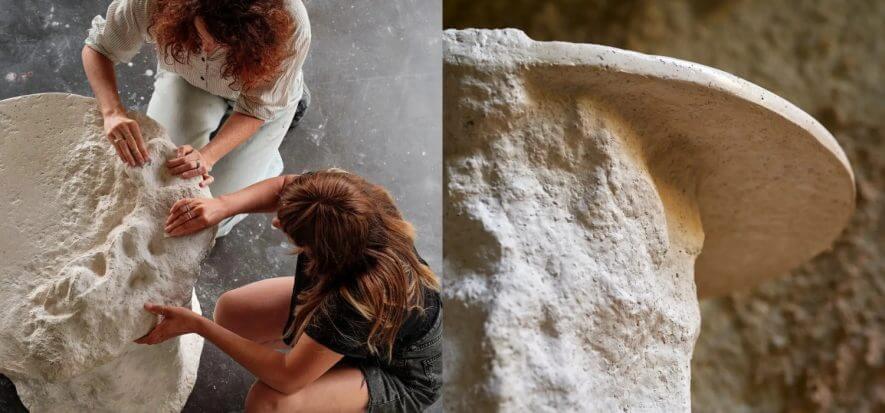
Five thousand square metres of countryside, a cold workshop and two pairs of hands that never stop moving. It is here that designer Rebecca Fezard and plaster artist Élodie Michaud have transformed an industrial by-product into a creative resource. Every year in France, thousands of tonnes of leather waste are discarded: a precious material, difficult to recycle, often destined for incineration.
From this observation comes Leatherstone — leather offcuts that become stone. A trompe-l’œil compound born from what would normally end up as waste. A material that brings together research and sustainability. Their work, awarded the Liliane Bettencourt Prize for L’Intelligence de la Main, highlights a new path in design: regenerating what is thrown away.
Leather offcuts turned to stone
As Connaissance des Arts reports, 15,000 tonnes of unusable leather waste are discarded in France every year. In their workshop in Neuvy-le-Roi, Fezard and Michaud knead it, shape it and transform it into a compound that they then spread out and which, once dry, takes on the hardness and materiality of stone. The leather offcuts — the true protagonists of the project — are ground down, mixed with natural elements that define their texture and enriched with vegetable oils that make the material waterproof and elastic. The result is a substance that can be worked like filler, sculpted like a mineral and used to clad chairs, tables, sculptures and architectural surfaces. Leatherstone is therefore not merely an alternative. It is an innovative way of giving new life to waste, turning it into a contemporary formal language.
New uses for leather
The duo do not limit themselves to leather. Apple residues, scallop shells, acetate offcuts from eyewear frames, textiles and wood are also turned into bricks, panels and decorative surfaces. But it is through leather that design takes on a structural dimension — one that has found practical applications from the outset. Beyond Tufo, the coffee table with which the duo won the prize, Leatherstone can in fact be used for furniture, worktops and cladding. “Our goal is to create a continuous exchange between our artisanal, cultural and decorative heritage and the environmental challenges of our time”, Michaud underlines. And what better way to elevate leather than by carrying it ever further into contemporaneity?
Photos by Julie Limont for the Bettencourt Schueller Foundation
Read also: